
Laboratory Mass Measurement Standards: Calibration & Unit Math
Explore laboratory mass measurement standards for analytical balance calibration, microgram to pound precision, and GLP metrology compliance.
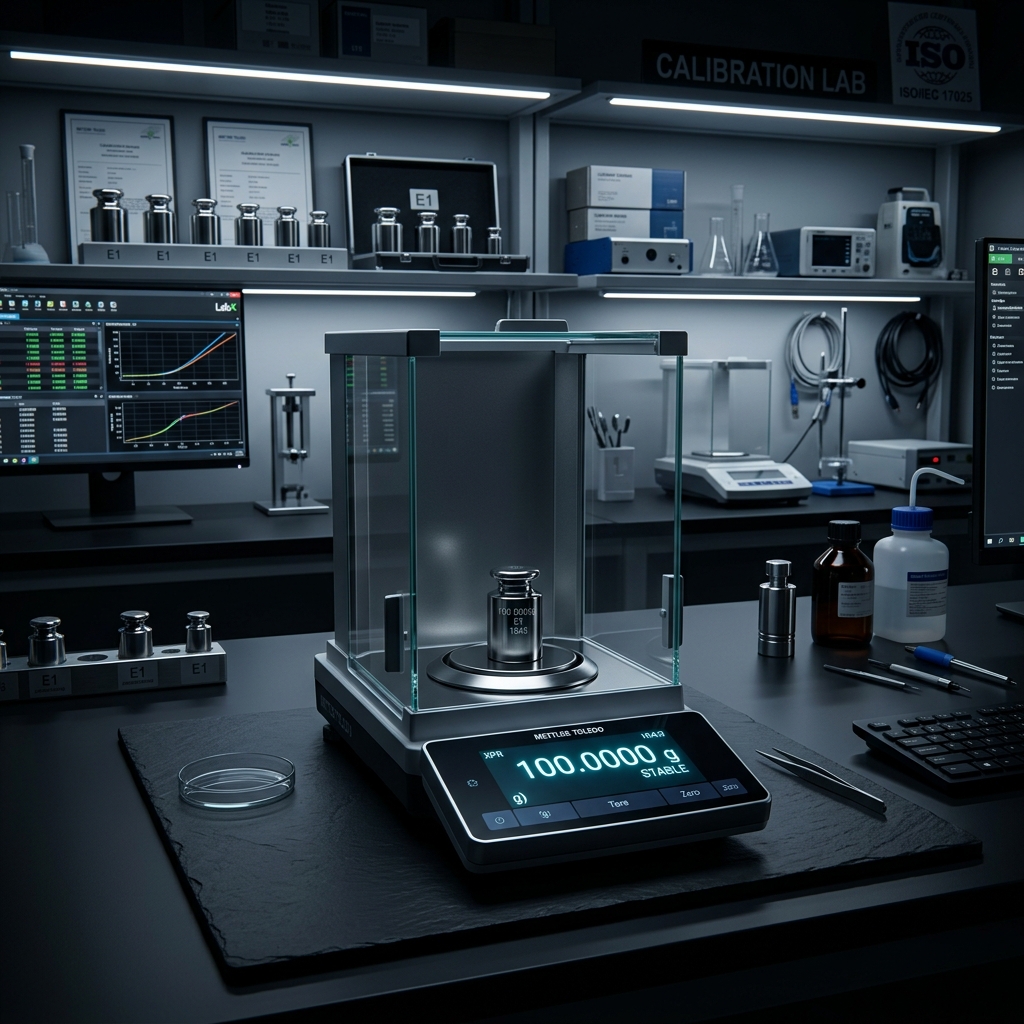
In research laboratories, pharmaceutical R&D, and certified testing facilities, adhering to international laboratory mass measurement standards ensures data reproducibility and legal compliance. Analytical balances weigh samples in milligrams (mg) or micrograms ($\mu\text{g}$), which must be converted into imperial units like pounds (lbs) for trade or manufacturing documentation.
In this guide, we examine laboratory mass measurement standards, review calibration weight classes, and detail precision mass conversion math.
Understanding ISO & OIML Laboratory Mass Measurement Standards
International metrology organizations (OIML and ASTM International) categorize calibration weights based on maximum permissible error (MPE):
- Class E2: Ultra-high precision weights used for calibrating analytical balances down to $0.01 \text{ mg}$.
- Class F1 & F2: Precision laboratory weights used for routine compounding and quality control.
- Class M1 & M2: Industrial weights used for commercial scales.
For micro-mass balance guidelines, read our article on 10 mg to lbs conversion.
For overall metrology history, see our milligrams to pounds conversion guide.
Balance Calibration & Mass Error Tolerances
| Weight Class | Nominal Weight | Permissible Error (MPE) | Pound Equivalent (lbs) |
|---|---|---|---|
| Class E2 | 100 mg | $\pm 0.016 \text{ mg}$ | 0.00022046 lb |
| Class F1 | 1,000 mg (1 g) | $\pm 0.10 \text{ mg}$ | 0.00220462 lb |
| Class F2 | 10,000 mg (10 g) | $\pm 0.50 \text{ mg}$ | 0.02204623 lb |
| Class M1 | 453,592 mg (1 lb) | $\pm 50.0 \text{ mg}$ | 1.00000000 lb |
Software developers creating scientific database systems rely on enterprise engineering—much like the services provided by custom software engineers.
Summary
Following recognized laboratory mass measurement standards protects scientific integrity and guarantees global unit equivalence.
For instant automated mass conversions, try our free mg to lb converter.