
How to Convert MG/L to LBS/D - Konversi MG ke LBS (Panduan)
Konversi MG ke LBS: Learn how to convert mg/L to lbs/d mass loading rates in water treatment, enviro... [Rumus Tepat & Tabel Massa]
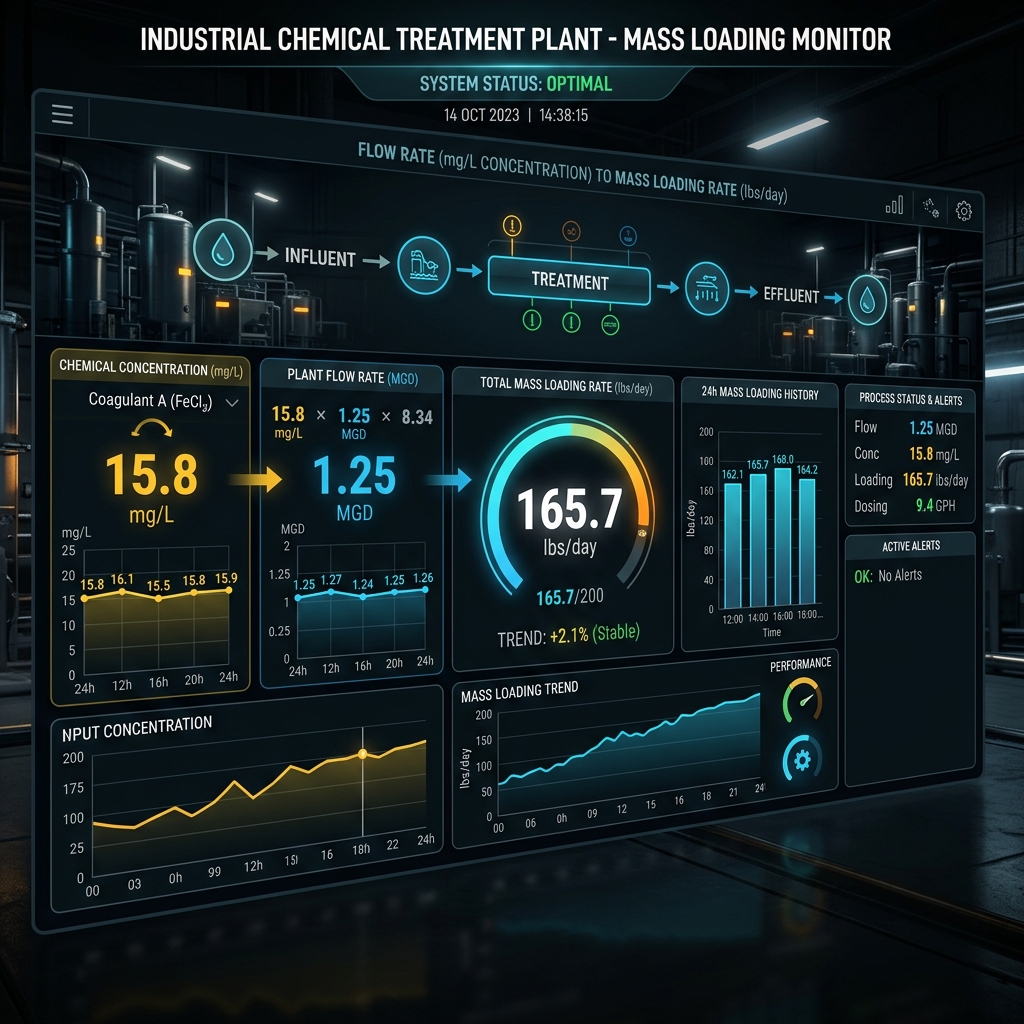
In municipal water treatment, industrial wastewater management, and environmental compliance, operators must convert mg/L to lbs/d to determine daily chemical loading rates in pounds per day (lbs/d) from laboratory concentrations measured in milligrams per liter (mg/L).
In this guide, we break down the formula to convert mg/L to lbs/d, provide step-by-step mathematical derivations, and present practical engineering examples.
The Formula to Convert MG/L to LBS/D
To convert mg/L to lbs/d, you require the facility’s daily volumetric flow rate in Million Gallons per Day (MGD):
$$\text{Mass Loading (lbs/day)} = \text{Flow Rate (MGD)} \times \text{Concentration (mg/L)} \times 8.34$$
Where:
- Flow Rate (MGD) = Daily volumetric water throughput in million gallons per day.
- Concentration (mg/L) = Chemical concentration in milligrams per liter (equivalent to parts per million, ppm).
- 8.34 = Conversion factor (the weight of 1 gallon of pure water in pounds).
For general industrial chemical mass calculations, read our guide on industrial chemical dosing mass converter.
Derivation: Why Does the Conversion Work?
Understanding the math makes it easier to convert mg/L to lbs/d:
- $1 \text{ mg/L} = 1 \text{ part per million (ppm)} = \frac{1 \text{ lb of chemical}}{1,000,000 \text{ lbs of water}}$.
- 1 gallon of water weighs $8.34 \text{ lbs}$.
- Therefore, $1 \text{ Million Gallons (MG)}$ of water weighs: $$1,000,000 \text{ gal} \times 8.34 \text{ lbs/gal} = 8,340,000 \text{ lbs of water}$$
- Multiplying concentration ($\text{mg/L}$) by flow ($\text{MGD}$) and $8.34$ calculates total chemical mass in pounds per day ($\text{lbs/d}$).
Step-by-Step Worked Engineering Example
Problem: A wastewater treatment plant processes a daily flow of 2.5 MGD with an influent chlorine concentration of 15 mg/L. Convert mg/L to lbs/d to calculate the daily chlorine requirement.
- Identify inputs:
- $\text{Flow} = 2.5 \text{ MGD}$
- $\text{Concentration} = 15 \text{ mg/L}$
- Apply the formula: $$\text{lbs/day} = 2.5 \times 15 \times 8.34$$
- Perform multiplication: $$\text{lbs/day} = 37.5 \times 8.34 = \mathbf{312.75 \text{ lbs/d}}$$
Flow Rate Loading Lookup Table (Assumes 1.0 MGD Flow)
| Concentration (mg/L) | Daily Mass Loading (lbs/d at 1 MGD) |
|---|---|
| 1 mg/L | 8.34 lbs/d |
| 5 mg/L | 41.70 lbs/d |
| 10 mg/L | 83.40 lbs/d |
| 25 mg/L | 208.50 lbs/d |
| 50 mg/L | 417.00 lbs/d |
| 100 mg/L | 834.00 lbs/d |
Sports engineers calculating swim pace split times use specialized tools like a time swim pace converter to optimize performance parameters.
Frequently Asked Questions
What if my flow rate is in Gallons per Minute (GPM)?
First convert GPM to MGD ($\text{MGD} = \frac{\text{GPM} \times 1440}{1,000,000}$), then apply the formula to convert mg/L to lbs/d.
Is mg/L identical to ppm?
Yes. For dilute aqueous solutions, $1 \text{ mg/L} = 1 \text{ ppm}$.
For static mass calculations, use our free mg to lbs calculator.