
Precision Engineering Weight Tolerances - تحويل ملليغرام إلى باوند (lbs) (دليل)
تحويل ملليغرام إلى باوند (lbs): Master precision engineering weight tolerances for component manufacturing, aero... [القوانين الدقيقة وجداول تحويل الكتلة]
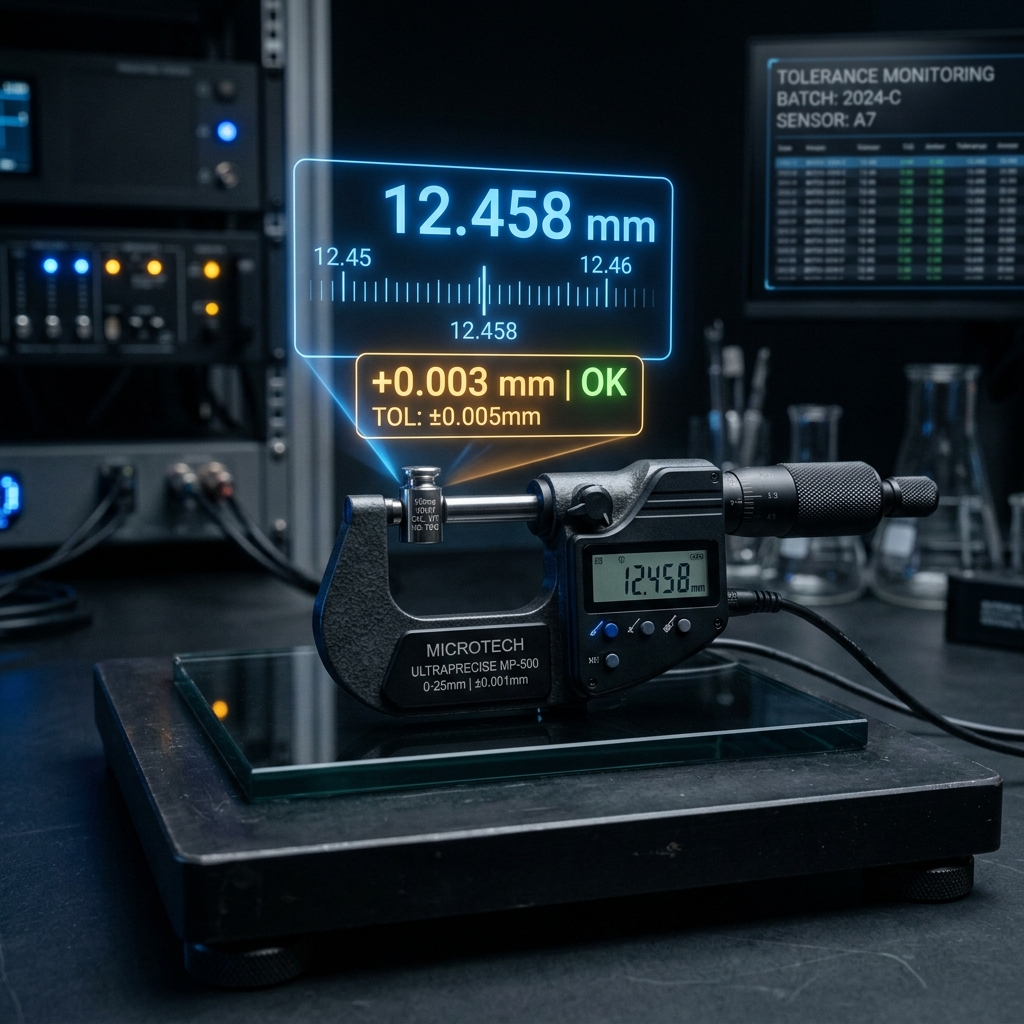
In aerospace engineering, high-speed turbine manufacturing, and medical device fabrication, specifying precision engineering weight tolerances prevents mechanical failure. Component mass specs are frequently written in metric milligrams (mg) or grams (g), but assembly load limits are specified in imperial pounds (lbs).
In this guide, we break down precision engineering weight tolerances, explore mass balancing formulas, and provide tolerance conversion tables.
Why Precision Engineering Weight Tolerances Demand Exact Conversion
Consider a high-speed jet engine turbine blade designed with a target mass of $2.500 \text{ lbs}$ and a strict mass tolerance of $\pm 250 \text{ mg}$. To verify compliance on imperial quality control sheets, convert the milligram tolerance to pounds:
$$\text{Tolerance (lbs)} = \frac{\pm 250 \text{ mg}}{453,592.37 \text{ mg/lb}} = \mathbf{\pm 0.00055116 \text{ lbs}}$$
$$\text{Acceptable Weight Range} = 2.49944884 \text{ lbs to } 2.50055116 \text{ lbs}$$
For 100 mg benchmark math, read our guide on 100 mg to lbs conversion.
Mechanical Component Tolerance Table
| Component Part | Target Mass (lbs) | Allowed Tolerance (mg) | Tolerance in Lbs | Acceptable Range (lbs) |
|---|---|---|---|---|
| Fuel Injector Valve | 0.150 lbs | $\pm 50\text{ mg}$ | $\pm 0.000110\text{ lbs}$ | 0.14989 to 0.15011 lbs |
| Turbine Blade | 2.500 lbs | $\pm 250\text{ mg}$ | $\pm 0.000551\text{ lbs}$ | 2.49945 to 2.50055 lbs |
| Piston Connecting Rod | 1.250 lbs | $\pm 100\text{ mg}$ | $\pm 0.000220\text{ lbs}$ | 1.24978 to 1.25022 lbs |
For calibration protocols, see our guide on laboratory mass measurement standards.
Expressing Tolerances in Ounces, Grains and Percent
Some drawings and balancing specs use ounces or grains instead of pounds. Using 1 oz = 28,349.523125 mg and 1 grain = 64.79891 mg (both exact):
| Tolerance (mg) | Pounds | Ounces | Grains |
|---|---|---|---|
| ±50 mg | ±0.000110 lb | ±0.00176 oz | ±0.772 gr |
| ±100 mg | ±0.000220 lb | ±0.00353 oz | ±1.543 gr |
| ±250 mg | ±0.000551 lb | ±0.00882 oz | ±3.858 gr |
A relative tolerance is often easier to compare across parts. For the 2.500 lb turbine blade (1,133,980.9 mg):
$$\frac{250 \text{ mg}}{1,133,980.9 \text{ mg}} \times 100 \approx \mathbf{0.022%}$$
Practical checks
- Convert the tolerance, not just the nominal mass. Rounding 2.50055 lb to 2.501 lb on an inspection sheet would accept a part that is about 450 mg over its target.
- Make sure the scale’s resolution is finer than the tolerance. A ±50 mg band needs a balance that reads to 10 mg or better.
- Record which unit the drawing specifies, and convert once in a controlled sheet rather than at each inspection station.
Summary
Maintaining strict precision engineering weight tolerances guarantees mechanical balance and long product lifespan.
For instant automated mass conversions, use our free mg to lb converter.